
Corporate Video Production Company vs. Freelancer Videographer: Which Should You Choose?

Corporate video production company vs. freelancer videographer: which should you choose?
This question usually comes up when you are comparing quotes. One freelancer comes in at $2,500. A production company comes in at $4,500 for the same shoot. The difference is the same every time, and most clients ask it wrong.
Here is what you are actually comparing, what the cost difference actually covers, and which model makes sense for your situation.
The real difference (it is not just price)
A freelancer is usually one person with a camera. A production company is a team with systems, insurance, and backup plans. That sounds obvious, but it changes everything when something goes wrong.
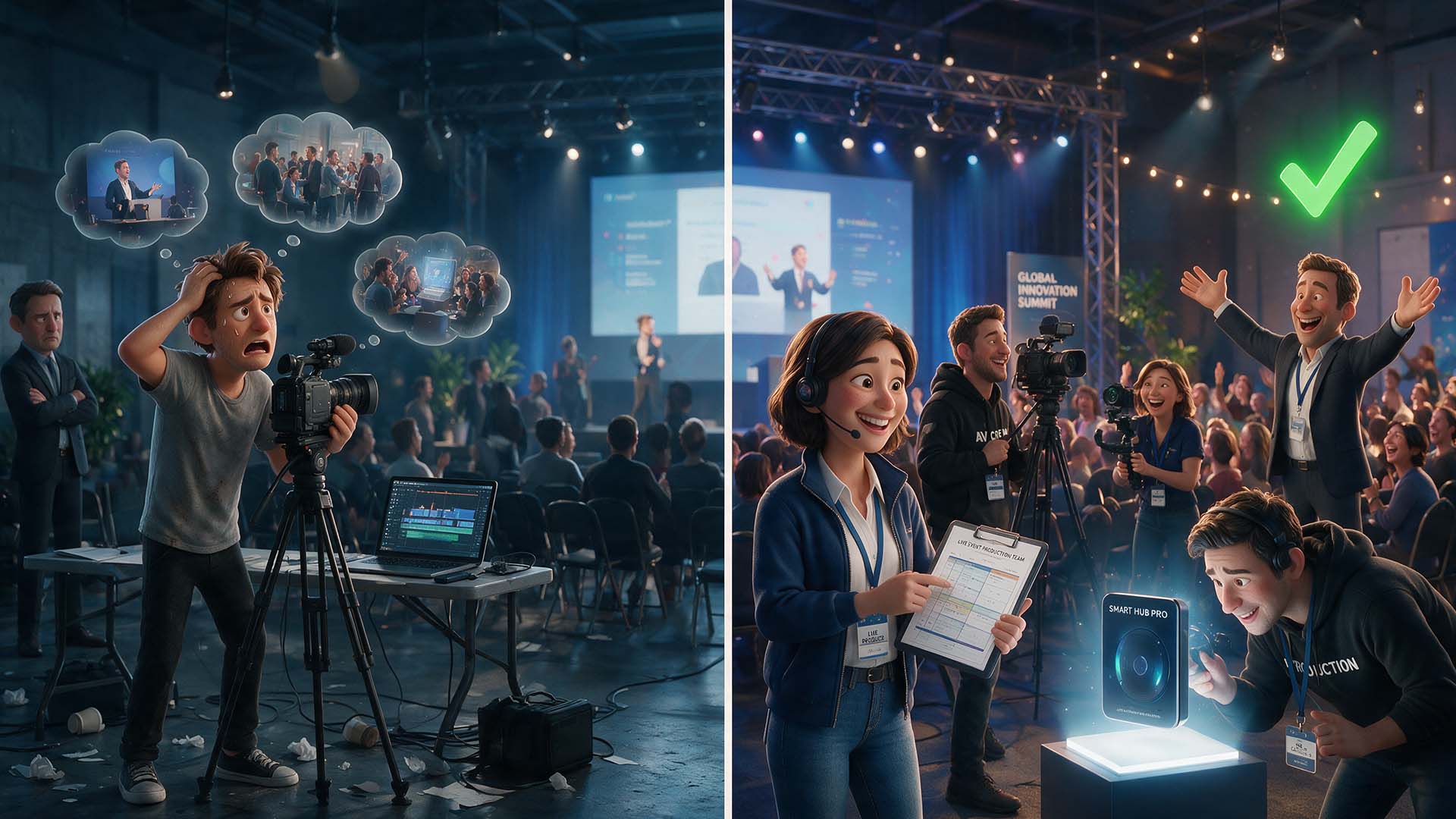
A freelancer who gets sick on the day of your shoot is a problem with no solution. They are your shoot. A production company whose lead camera operator gets sick has a backup camera operator on standby. They send them instead.
A freelancer's hard drive fails after the shoot. Your footage might be gone. They probably do not have redundant backup systems because those cost money they do not have. A production company has multiple backups, redundant storage, and can recover from a drive failure without you losing days of work.
A freelancer who over-commits gets stressed and delivers mediocre work because they are juggling too many projects. A production company with project management has a producer checking on timeline and quality, so your shoot does not slip into someone else's deadline stress.
These are not small differences when you are building marketing assets that matter to your business.
Price comparison: what you are actually paying for
Freelancer rate: $2,500 for a full day
- One person with a camera
- One angle coverage (maybe two)
- Basic editing (1-2 weeks turnaround)
- No backup equipment or crew
- No project management
- No insurance (sometimes)
- You assume the risk
Small production company rate: $3,500 to $4,500 for a full day
- Lead camera operator
- Production assistant or second camera
- Better equipment backup and redundancy
- Basic project management
- Professional insurance
- Faster turnaround (usually 1-2 weeks, but priority clients get faster)
- Company assumes some risk
Larger production company rate: $5,000 to $7,000+ for a full day
- Full crew (operator, focus puller, producer, audio specialist)
- Multi-camera capability
- Advanced post-production (colour grading, graphics, titles)
- Comprehensive backup systems
- Dedicated project manager
- Professional insurance and liability coverage
- Fastest turnaround and priority support
- Company bears the risk
The price difference is not just labour. It is redundancy, systems, accountability, and insurance that protects you if something goes sideways.
When to hire a freelancer
Freelancers make sense in a few specific situations.
1. Budget is your only constraint You have $2,000 and that is all you have. A freelancer is your only option. Be aware of the risks you are taking on, but sometimes the budget decision is made for you.
2. You do not care about the outcome Internal training video that will be watched once by three people. Documentation footage that nobody will see. If the production value does not matter and failure is not a risk, a freelancer is fine.
3. You are testing before committing You have never done video before and want to test the waters without investing. A freelancer is a lower-cost experiment. If it works, invest in a company for your next shoot.
4. You need a specific creative speciality and they are the expert Some freelancers specialise in a specific style (animation, motion graphics, documentary-style interviews). If they are the best at that thing and you need that thing, hire them. Speciality trumps scale.
Beyond these situations, a production company is the better choice. Here is why.
When to hire a production company
1. Your shoot cannot fail Product launch, investor pitch, conference keynote. If the footage is mission-critical and failure is not an option, you need redundancy. A production company gives you that.
2. You need professional accountability A freelancer who delivers late is a problem you absorb. A production company that delivers late damages their reputation. They have insurance, contracts, and accountability structures. You have recourse.
3. You want faster turnaround Freelancers often work solo and editing takes time. Production companies have multiple editors and can prioritise your project. If you need the video in one week, a freelancer might not be able to do it.
4. You need post-production beyond basic editing Colour grading, motion graphics, sound design. A freelancer might handle basic editing. A production company has specialists in each of these areas.
5. You are building a long-term relationship If you plan to do video again in six months, and then again a year after that, a production company is easier to work with. They know your brand, your process, your preferences. You do not have to onboard a new person each time.
6. You need multi-camera or live coverage One camera operator shoots one angle. Two camera operators shoot two angles simultaneously. A freelancer cannot do this. A production company can.
Hidden costs of hiring a freelancer
Going cheap upfront often costs more later.
Scenario 1: Reshoots Freelancer delivers footage you do not like. You ask for reshoots. They have already moved on to the next client. Scheduling takes weeks. When they finally reshoot, the lighting is different, the talent has a different haircut, the season has changed. The footage does not match. Now you have unusable material and you are out the original fee.
Cost: Original $2,500 plus $2,500 reshoot plus your time and frustration.
Scenario 2: Revision overloadFreelancer delivers an edit. You ask for changes. They ask how many rounds of revision are included. The answer is usually "unlimited" until it hits their patience limit, then it costs $75/hour. Your small changes become expensive. You end up accepting a mediocre edit because the revision costs are adding up.
Cost: Original $2,500 plus $500-$1,500 in revision fees.
Scenario 3: Missed deadlineFreelancer over-commits and your project gets pushed back. You need the video for a campaign that launches in two weeks. It does not arrive until after launch. The video misses its window and does not drive the results you expected.
Cost: Original $2,500 plus lost campaign ROI (potentially thousands).
Scenario 4: Technical failureFreelancer's backup drive fails. You lose the footage. The shoot needs to be re-done, which means additional cost, re-scheduling talent, re-taking time out of everyone's day. Freelancer has no insurance to cover it.
Cost: Original $2,500 plus $2,500 reshoot plus all your re-scheduling time.
These scenarios happen more often than you would think. A production company's systems are specifically designed to prevent them.
The freelancer advantage (it does exist)
Freelancers are sometimes better for very specific reasons.
Speciality expertise: Some freelancers have skills or styles that bigger companies do not offer. If you need a specific look or technique, a specialist freelancer is worth the risk.
Budget constraints: If you literally cannot afford a production company, a freelancer is your only option. Just manage your expectations and risk accordingly.
Faster communication: One person instead of a team means faster decision-making. You call the freelancer, they pick up. You do not have to wait for a producer to loop in the editor who then talks to the camera operator. Sometimes speed and simplicity win.
Intimacy and trust: If you have worked with a freelancer for years and they know your brand inside-out, that relationship has value. Switching to a company means re-onboarding. Stick with who knows you.
These are real advantages. They just do not usually outweigh the reliability and scale of a production company for corporate work.
Production quality is not the dividing line
Here is the thing nobody talks about: a skilled freelancer can produce work as visually beautiful as a production company. Technically, a great freelancer with good gear and a steady hand can shoot footage that looks professional.
Where they differ is not in the beauty of the image. It is in what happens when things go wrong, when you need fast turnaround, when you need multiple camera angles, or when your project is too important to risk on a single person.
A freelancer might deliver a gorgeous 3-minute video. A production company might deliver an equally gorgeous 3-minute video, but with the backup systems that mean you actually get it.
That is the difference.
Corporate video at WVFRM
We are a production company, not a solo freelancer. We bring a crew, systems, redundancy, and accountability. For corporate clients building assets that matter, that is what wins.
On a $5,000 corporate video project, you get a lead camera operator, a production assistant, backup equipment, professional insurance, project management, and a commitment to turnaround and revision. If something breaks on shoot day, we have backup systems. If you need changes, we have an edit team. If you want the video faster, we prioritise it. Learn more about how we deliver seamless client experiences.
That reliability is what corporate clients pay for.
If you are comparing freelancers to production companies and price is the only factor, a freelancer wins. If you are comparing on outcomes, accountability, and risk management, a production company is the better investment.
Not sure which model suits your project? Get in touch with a brief and we will tell you honestly if a freelancer would work or if you need a production company.


.svg)